
Share
%201.webp)


By:
Hans Allí

Case Study: How We Redesigned a Client Website to Increase Leads by 40%
The Challenge: A Great Business With an Underperforming Website
When this client first approached Dthree Digital, they had a problem many Philippine businesses face. Their company was well-respected in their industry, had a loyal client base, and delivered excellent work. But their website told a different story. Built over five years earlier, the site was slow, visually outdated, and not optimized for mobile devices. Most critically, it wasn’t generating the leads their growing business needed.
Despite strong word-of-mouth referrals, the client was losing potential customers at the digital front door. Prospects who searched online and landed on their site were bouncing quickly. The website’s contact form was buried, the services weren’t clearly communicated, and the overall experience felt disconnected from the quality of work the company actually delivered.
They needed more than a visual refresh. They needed a website that worked as a lead generation tool.
Discovery: Understanding What Wasn’t Working
Before designing anything, we conducted a thorough audit of the existing website. This discovery phase is something we do with every project because it ensures our design decisions are grounded in data, not assumptions.
What the Audit Revealed
The site had a bounce rate of 68%, meaning more than two-thirds of visitors left without exploring beyond the first page. Average page load time was 6.2 seconds on mobile — more than double the recommended 3-second threshold. The site was not mobile-responsive, which was especially problematic given that over 65% of their traffic came from mobile devices. There were no clear calls-to-action on the homepage or service pages. The contact form required filling out 8 fields, creating unnecessary friction for potential leads. And the site had minimal SEO optimization — no structured data, thin meta descriptions, and no blog content to drive organic traffic.
Competitor Analysis
We also analyzed the websites of five direct competitors. We found that the top-performing competitors had clean, modern designs with clear value propositions above the fold, prominent CTAs on every page, fast load times under 3 seconds, and active blogs driving organic search traffic. This analysis helped us identify specific opportunities to differentiate our client’s redesigned site.
Strategy: Designing for Conversion, Not Just Aesthetics
Based on our findings, we developed a strategy built around three priorities: speed, clarity, and conversion. Every design and development decision we made served at least one of these goals.
Speed
We moved the site to Webflow, which gave us built-in performance optimization, CDN hosting, and automatic image compression. We targeted a load time under 2.5 seconds on mobile.
Clarity
We restructured the site architecture to ensure visitors could understand what the company does, who they serve, and how to get in touch within the first 5 seconds of landing on any page. Service pages were rewritten with clear benefit-focused messaging.
Conversion
We redesigned the user journey with strategic CTAs placed throughout the site. The contact form was simplified from 8 fields to 4. We added a sticky header with a “Get a Quote” button visible on every page. And we incorporated trust signals — client logos, testimonials, and project highlights — prominently throughout the site.
Design and Development
The design phase focused on creating a visual identity that matched the quality of the client’s work. We chose a clean, modern aesthetic with generous white space, professional photography, and a restrained color palette that conveyed trust and expertise.
Key design decisions included a homepage hero section with a clear headline, supporting text, and a primary CTA button above the fold. Service pages structured with benefits first, followed by process details, then social proof, and finally a CTA. A portfolio section with filterable project categories and results-focused case study summaries. And a simplified footer with contact information, quick links, and a secondary CTA.
Development was completed in Webflow over 8 weeks, including responsive design testing across all major devices and browsers. We implemented structured data for local SEO, optimized all images for web performance, and set up Google Analytics 4 with custom conversion tracking.
The Results: Measurable Impact Within 90 Days
The impact of the redesign was measurable almost immediately. Within the first 90 days after launch, we tracked significant improvements across every key metric.
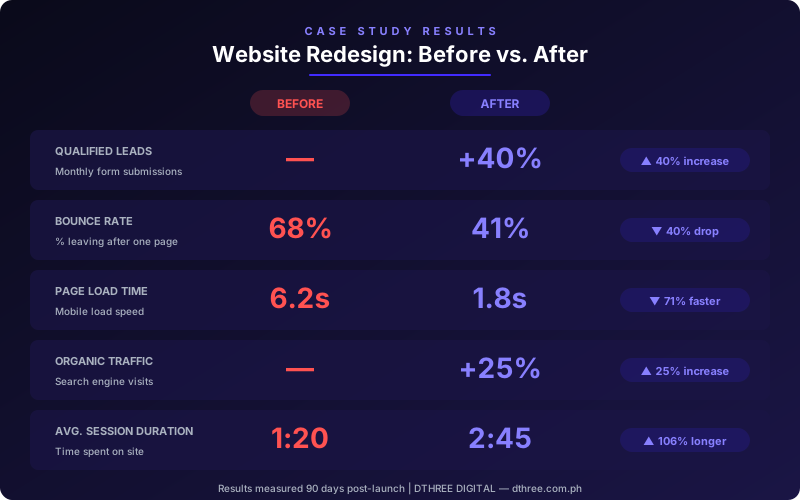
Qualified leads increased by 40% compared to the same period the previous year. This was the metric that mattered most to the client, and the improvement was driven by the simplified contact form, prominent CTAs, and clearer service messaging.
The bounce rate dropped from 68% to 41% — a 40% improvement. Visitors were staying longer and exploring more pages because the content was organized logically and the design invited further engagement.
Page load time improved from 6.2 seconds to 1.8 seconds on mobile. This alone reduced the abandonment rate significantly, especially for the majority of visitors accessing the site from smartphones.
Organic search traffic increased by 25% within the first three months, driven by improved technical SEO, structured data implementation, and the addition of optimized service page content.
The average session duration increased from 1 minute 20 seconds to 2 minutes 45 seconds, indicating that visitors were engaging more deeply with the content.
Key Takeaways for Your Business
This project reinforced several principles that apply to any business website redesign.
First, speed matters more than most businesses realize. A slow website isn’t just a technical issue — it directly costs you leads and revenue. Wondering how much a proper website investment costs? Our pricing guide breaks it down. Investing in performance optimization is one of the highest-ROI improvements you can make.
Second, clarity converts. Visitors shouldn’t have to work to understand what you do or how to contact you. The simpler and clearer your messaging and CTAs, the more leads your website will generate.
Third, data should drive design decisions. Our audit and competitor analysis gave us concrete targets and priorities. Without this foundation, redesigns often become subjective exercises that look different but don’t perform better.
Fourth, the platform matters. Moving to Webflow gave us performance advantages that would have been much harder and more expensive to achieve on the client’s previous platform.
Is Your Website Due for a Redesign?
If your website is more than three years old, loads slowly on mobile, or isn’t generating the leads your business deserves, it may be time for a strategic redesign. The investment pays for itself through improved performance and lead generation.
Dthree Digital specializes in results-driven website redesigns for Philippine businesses. Explore our services or contact us to discuss your project.
.webp)