
Share
%201.webp)


By:
Hans Allí

What Makes a Great Business Website? Lessons From 10 Years of Professional Web Design
Most Business Websites Fail at the Basics
After more than a decade of building websites for companies across the Philippines, one thing is clear: the difference between a website that works and one that doesn't usually comes down to fundamentals. Not trends. Not flashy animations. Not the latest framework.
We've built over 500 websites at Dthree Digital. Corporate sites, nonprofit platforms, university portals, membership directories, ecommerce stores. The projects that delivered real results for clients all shared a handful of qualities. The ones that underperformed almost always skipped the same steps.
This post is a distilled version of what we've learned. If you're planning a new website or evaluating your current one, this is the checklist that actually matters.
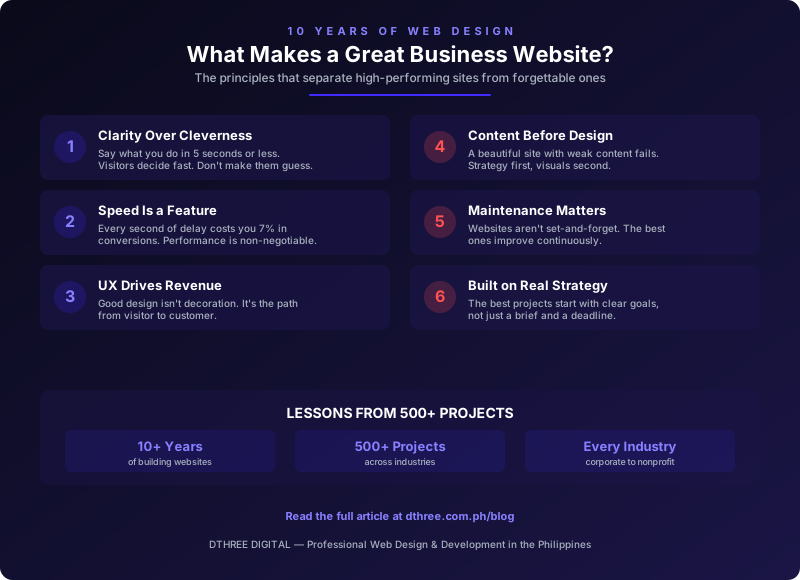
Clarity Over Cleverness, Every Time
The single most common problem we see in business websites is unclear messaging. A visitor lands on your homepage and within five seconds, they should know three things: what you do, who you do it for, and what they should do next.
That sounds simple. It is not. Most companies want to say everything at once. They lead with mission statements, company history, or vague taglines that sound impressive but communicate nothing. "Innovative solutions for a connected world" tells a visitor absolutely nothing about your business.
What works instead
- A clear headline that names the service or product and the audience. "Web design for Philippine businesses" is more useful than "Digital excellence, delivered."
- A subheading or short paragraph that adds one layer of specificity. What kind of businesses? What kind of results?
- A visible call-to-action above the fold. Not buried. Not subtle. A button that says exactly what happens when you click it.
We redesigned a corporate site for a professional services firm in Makati that had a bounce rate above 70%. Their homepage opened with a full-screen video and a one-word tagline. After replacing it with a clear value proposition and a direct CTA, their bounce rate dropped to 41% within two months. No other changes. Just clarity.
Speed Is Not a Technical Detail. It Is a Business Decision.
Philippine internet speeds have improved significantly over the past few years, but they're still inconsistent. Your site needs to load fast on a mid-range Android phone connected to mobile data in Quezon City, not just on a MacBook Pro connected to fiber in BGC.
Google has been clear that page speed affects search rankings. But the bigger cost is simpler than SEO: slow sites lose visitors. Every additional second of load time increases the chance that someone hits the back button and goes to your competitor.
Common speed problems we fix in almost every audit
- Uncompressed images. A 4MB hero banner is not acceptable. Most hero images should be under 200KB after compression and proper formatting.
- Too many fonts. Every custom font adds load time. Two weights of one typeface will cover most designs.
- Excessive scripts. Chat widgets, analytics tools, tracking pixels, and third-party integrations all add up. If you're loading five JavaScript files before the page even renders, you have a problem.
- No caching strategy. Static assets should be cached. Pages that don't change hourly should not be regenerated on every visit.
A good target: your homepage should score above 80 on Google PageSpeed Insights for mobile. If it scores below 50, you are actively losing traffic and leads.
Good UX Directly Affects Revenue
User experience is not decoration. It is the structure that guides a visitor from interest to action. When we work on a client project, we map the user journey before we open a design tool. Where does a visitor come from? What are they looking for? What objections do they have? What is the shortest path to conversion?
For a B2B company, conversion might mean filling out a contact form. For an ecommerce store, it means completing a purchase. For a nonprofit, it could mean a donation or a volunteer sign-up. The specifics change, but the principle stays the same: every page should move the visitor closer to a defined goal.
UX patterns that consistently perform well
- Sticky navigation on long pages, so the menu is always accessible.
- Contact information visible on every page, not hidden in a submenu.
- Forms with as few fields as possible. Every additional field reduces completion rates. Ask for the name, email, and one qualifying question. Get the rest on the call.
- Social proof placed near conversion points. Testimonials, client logos, and case study links work best when they appear right before or beside the CTA.
- Mobile-first layout. More than 70% of web traffic in the Philippines comes from mobile devices. If your mobile experience is an afterthought, you're designing for the minority.
We worked with an organization that had a contact form buried three clicks deep with 12 required fields. After moving it to a dedicated page linked from the main nav and trimming it to four fields, form submissions increased by more than 300%. The leads were just as qualified. The friction was just gone.
Content Strategy Matters More Than Visual Design
This is the hardest thing to explain to clients, but it's true: a well-structured website with average visuals will outperform a beautifully designed website with poor content every time.
Visual design is important. It builds credibility and communicates professionalism. But content is what people actually read, evaluate, and act on. If your service pages are vague, if your about page reads like a Wikipedia entry, if your blog hasn't been updated in two years, no amount of design polish will fix the trust gap.
What a solid content strategy looks like
- Each service page answers the questions a prospect would actually ask. What is this? How does it work? What does it cost (or at least, what determines the cost)? Why should I choose you?
- Case studies or project examples that show results, not just deliverables. "We redesigned their website" is not a case study. "We redesigned their website and lead volume increased by 150%" is.
- A blog that demonstrates expertise and answers real questions your target audience is searching for. Publish consistently, even if it's once a month.
- Updated information everywhere. If your footer says "© 2021" or your team page lists people who left two years ago, visitors notice.
We always recommend that clients prepare their content before design begins, or at least in parallel. Designing a page layout before you know what the page needs to say is working backwards. The content should shape the design, not the other way around.
A Website You Don't Maintain Is a Website That Decays
Launching a website is not the finish line. It's the starting point. Every site needs ongoing attention: software updates, security patches, content refreshes, performance monitoring, and periodic design reviews.
We've seen too many companies invest PHP 300,000 or more in a new website, then neglect it for three years until it breaks or becomes embarrassingly outdated. By that point, they need another full rebuild. That cycle is expensive and completely avoidable.
A realistic maintenance plan
- Monthly: Check for broken links, update plugins or platform software, review analytics for any traffic anomalies, publish at least one new piece of content.
- Quarterly: Run a speed test and fix any regressions. Review top-performing and underperforming pages. Update any outdated information (team changes, new services, revised pricing).
- Annually: Conduct a full audit. Evaluate whether the site still reflects your current business, branding, and goals. Assess the competitive landscape. Decide whether you need a refresh, a redesign, or just targeted improvements.
If you're unsure whether your current site needs attention, we wrote a companion post that covers the 10 signs your business website needs a redesign. It's a practical checklist you can run through in 10 minutes.
What Successful Website Projects Have in Common
After 500+ projects, the pattern is impossible to miss. The websites that delivered the best outcomes for our clients all shared these characteristics during the project itself:
1. A clearly defined goal before any design work started
Not "we need a new website." Something specific: "We need to increase quote requests by 50%" or "We need our services to rank on the first page for [specific term] in Manila." A defined goal shapes every decision that follows, from page structure to content to design.
2. A single decision-maker on the client side
Committee-driven website projects almost always produce watered-down results. The best outcomes happen when one person owns the project, gathers internal feedback, and makes final calls. That person doesn't need to be the CEO. They need authority and availability.
3. Content delivered on time
The most common cause of website project delays is not design or development. It is content. Companies underestimate how long it takes to write service descriptions, gather testimonials, take team photos, and compile case studies. The projects that launch on schedule are the ones where content preparation starts early.
4. Trust in the process
Clients who hire a web design consultancy and then override every recommendation based on personal preference end up with a website that reflects their taste instead of their audience's needs. The best client relationships involve honest dialogue. Push back when something doesn't feel right, but also trust the experience you're paying for.
5. A post-launch plan
The clients who see long-term results from their websites are the ones who plan for what happens after launch. Who updates the blog? Who monitors performance? Who handles technical maintenance? These questions should be answered before the site goes live, not six months later when something breaks.
The Bottom Line
A great business website is not the one with the most features or the most striking design. It is the one that clearly communicates your value, loads quickly, guides visitors toward action, and is maintained over time. That's it. Get these right and the website becomes one of the most effective tools your business has.
If you're evaluating whether your current website meets these standards, or if you're planning a new build, we'd be happy to talk through it. You can see examples of our work on our projects page, review our full range of services, or get in touch directly.
.webp)